AI job interviews are here. But what are you actually being assessed on?
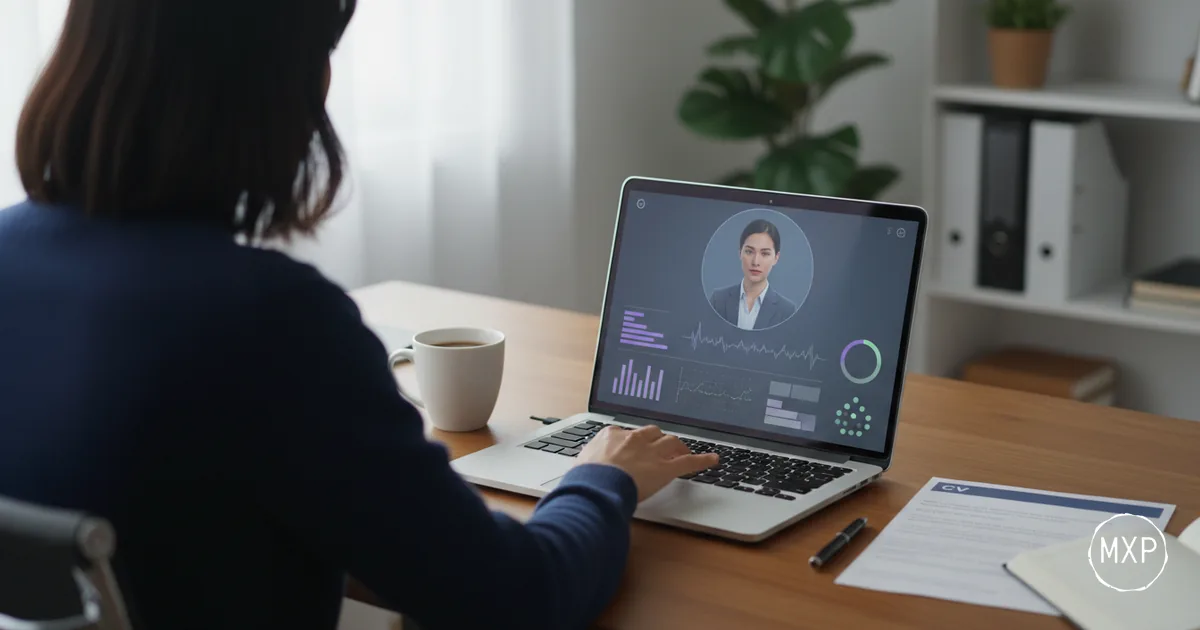
Until fairly recently, an automated interview usually meant recording yourself answering a fixed set of questions. The recruiter watched the videos later, assuming they had the time and inclination to sit through all of them.
The newer AI interview systems such as Alex, Ribbon and HireVue go quite a bit further. They can conduct the first screening interview themselves. In its simplest form, the recruiter sends an email invitation with a link, much as they would when scheduling a Teams, Zoom or Webex call. Some systems can take even that piece away from the recruiter, triggering interview invitations automatically when an applicant meets the initial criteria set for the job.
Once the invitation is accepted, the candidate may sit down at their desk with the microphone and camera switched on, pretty much as millions of us did while working from home during Covid. Except this time there may be no recruiter on the other side of the call. Depending on the system, you could be talking to a voice, an on-screen interviewer or an avatar that asks questions, listens to the answers and responds to what you have said.
It is one of the more surreal experiences a jobseeker can go through, and like it or not, it is becoming part of the process for certain functions and levels of roles.
A recruiter, on a good day, might physically and mentally get through eight or ten proper interviews. And that assumes they are fully committed to interviewing for most of the day, preparing properly, following through on answers, taking notes good enough to remember one candidate from another and giving everybody a fair shake without falling into the normal comparison trap. The last guy was brilliant, therefore this guy suddenly seems worse than he actually is.
Now take a customer service vacancy with 300 applicants.
If an employer invites all 300 to an AI interview and only half accept and turn up, that is still 150 people who can potentially complete a first-stage interview within a day or two. There is no recruiter calendar to fill, no lunch break, no meeting running over and, where the ATS hasn't already filtered for right-to-work, no recruiter spending twenty minutes arranging and conducting a call with somebody in Mumbai who needs visa sponsorship for a role where the employer has already said none is available.
The AI interviewer can ask the initial questions, listen to the answers and follow up with second or third questions where something needs more detail. Once the interview is finished, the transcript can be assessed alongside the CV and scored against the requirements of the job. Depending on how the employer has set things up, candidates who meet the required level can be presented to the recruiter with a recommendation or moved into whatever assessment stage comes next.
The recruiter can then receive considerably more than the notes they might have scribbled during a normal screening call. There may be a recording, transcript, summary, scores against individual requirements and flags showing where something needs a closer look.
What matters to the candidate is much simpler. They need to know what the system is assessing, how those answers are scored and what eventually lands in front of the recruiter.
There isn't just one AI interview score
There seems to be a growing assumption that somewhere inside an AI interview platform there is a universal score deciding whether somebody is good enough to get a job.
There isn't.
The employer still has to decide what matters for the role.
HireVue, for example, allows interview questions and scoring criteria to be built around the job requirements. Ribbon uses employer-defined scorecards. Alex uses interview guides and produces role-fit scores based on the criteria it has been given.
So a customer service interview might be looking for evidence of dealing with difficult customers, handling complaints, working under pressure and hitting service targets. An accounts payable role may concentrate on reconciliations, invoice volumes, ERP systems and dealing with discrepancies. A software role will obviously head off in another direction entirely.
Which brings us back to something candidates have been told for years but don't always do.
Read the job description properly.
If the employer has gone to the trouble of setting up an AI interview around six or eight things they believe matter for the job, there is a fair chance those same six or eight things are sitting in the advert.
The AI has not independently decided what makes somebody a good customer service manager. The employer has given it a brief.
Your answer will still need evidence behind it
A lot of interview answers sound better on first hearing than they do when somebody starts pulling at them.
"I led the implementation."
Fine. What did you actually lead?
"We improved customer satisfaction."
By how much, over what period, and what did you change?
"I managed a difficult stakeholder."
What made them difficult and what did you do about it?
A decent recruiter will keep going until they understand what happened and, importantly, what the candidate personally did.
The better conversational AI systems can now do much the same thing. They are not restricted to asking Question One, waiting for an answer and moving obediently to Question Two. They can pick something out of an answer and ask about it.
That is a significant change from the old recorded video interview.
It also means the polished answer you spent an hour rehearsing the night before may not get you very far if the experience underneath it is thin.
The first answer might be perfect. The second question is where things can start coming apart.
That is why I would spend less time trying to predict the exact wording of the questions and more time making sure I knew my own examples properly.
If you really did manage the project, you should be able to talk about why it started, what went wrong, who objected, what you changed and what happened afterwards without needing a prepared script.
And be careful with "we".
Recruiters hear it constantly.
We launched the new system. We fixed the problem. We increased revenue. We reduced complaints.
All very impressive, but unless the whole department is attending the interview, the employer still needs to know what you did.
A human recruiter will normally stop somebody and ask. An AI interviewer may do the same, but there is not much point waiting to be rescued by the follow-up question.
What is it doing with your face and voice?
This is probably where more rubbish is written about AI interviews than anywhere else.
Smile at the camera. Don't look away. Maintain eye contact. Sit perfectly still. Use a particular tone of voice.
Before following any of that advice, it is worth knowing what the system being used by the employer actually measures.
HireVue, for example, says its AI-scored video assessments use the transcript of what the candidate says and do not score facial expressions, appearance, body language or tone of voice.
That does not mean the camera and microphone are irrelevant.
Some systems can use them for a completely different reason.
Alex has a separate proctoring function that can look for things such as another voice in the room, switching browser tabs, sustained off-screen glances or answers that appear to be coming from an outside source. In other words, a system may monitor something during an interview without using it to decide whether you are good at the job.
A candidate staring rigidly into the webcam because somebody on TikTok told them the algorithm is measuring eye contact could spend the entire interview looking slightly deranged for absolutely no benefit.
The sensible approach is to find out which platform is being used and read what that platform says about its own assessment.
The recruiter gets a different view of you
There is another difference between an AI screening interview and the recruiter phone call it may be replacing.
The old recruiter call depended quite heavily on the recruiter.
Twenty minutes later they might have a page of excellent notes. They might have six bullet points. They might have written "good candidate, Java, €70k, 4 weeks" and then spent the following morning trying to remember which conversation that note belongs to.
A well-run AI interview also leaves the recruiter with a much better record than the hurried notes that often come out of a normal screening call. They can go back to the recording, search the transcript and see how the candidate answered against each of the requirements being assessed.
That can be revealing in either direction. A polished CV can start to look a lot thinner once the detail is tested. But the opposite can happen too. Somebody who looked fairly ordinary on paper can suddenly make much more sense once they are given the chance to explain what they have actually done.
There is actually a good example of that in Alex's own customer material. The University of Alberta says its AI interviews surfaced two candidates its professors had not originally shortlisted because their CVs did not align particularly well with the advert. Both subsequently moved forward in their interview processes.
That is the horses-for-courses part of this that tends to get lost.
AI interviewing can be used as another barrier, or it can let an employer speak to far more people than a recruitment team could ever physically interview.
Used well, AI interviewing can widen the first-stage pool and give recruiters more evidence to work with. Used badly, it just automates a poor recruitment process faster.
Some candidates will take to this much more easily than others
I suspect age will play a part here, although I would be wary of drawing a neat line through the generations.
Someone in their early twenties has spent a large part of their life talking into phones, recording video, using voice assistants, sending voice notes and communicating through screens. Sitting in front of a computer and talking to software may still feel strange, but the mechanics of it probably won't.
Today, as I write this, I’m in my mid-50s. I’ve spent most of my career as a recruiter or hiring manager, usually sitting on the other side of the table. I’ve also worked directly with AI interviewing platforms, adapting them to client needs and culture and integrating them into company ATS platforms.
In fact, the last recruitment company I worked for, Allen Recruitment was a very early adopter of Apriora, the AI recruitment platform now known as Alex. My boss at the time, Brian Cunningham, worked closely with Apriora, advising and helping them shape parts of their workflow and the guardrails around the product. Allen Recruitment deployed the Apriora platform early. As Talent Acquisition Manager at the company I was one of the first recruiters in Europe to get a proper look at what these systems could do and where they might fit into a real recruitment process.
FYI, as an aside, Brian is brilliant at this stuff, if you are bringing a Recruitment application or product to market, do yourself a favour, and reach out to him. He’ll give you real end-user recruitment insight from both a workflow usability and data perspective.
My own experience with AI interviewing has been fairly hands-on. I’ve worked with the technology as a recruiter. I’ve also helped fit it into the real hiring workflows of several companies as an AI Product Builder. So I have seen firsthand what AI interviewing platforms can do in practice.
That said, someone in their early twenties has still grown up with a very different relationship to screens, video, voice interfaces and chatbots than somebody of my generation. It would be surprising if that had no effect at all on how natural an AI interview feels.
That does not mean younger candidates will automatically like them or older candidates will not. Greenhouse’s 2026 research found plenty of scepticism across age groups, particularly when employers failed to explain properly how AI was being used. In practice, the reaction may have as much to do with how the process is introduced as with the technology itself.
There is another thing an employer may pick up from the process itself. In some roles, an AI-led interview gives a small indication of how comfortable a candidate is working with AI.
That will be irrelevant for plenty of jobs. But where AI copilots, agents and automated tools are already part of the working day, a candidate's ability to engage with the technology without being thrown by it may carry some weight with the recruiter reviewing the interview.
But think about the direction workplaces are moving.
AI assistants are already in Microsoft 365, Google Workspace, CRM systems, customer service platforms, development tools, HR software and pretty much every other piece of workplace technology. In plenty of jobs, people are already working with AI every day. That will only increase.
So if somebody is applying to a company making heavy use of AI and refuses point blank to engage with an AI-led first interview, the human who eventually reviews that application may reasonably form a view about how comfortable that person is going to be working with similar technology.
Equally, somebody who sails through an AI interview is not automatically more capable or more adaptable.
It is simply another piece of information.
For some roles it will matter. For others it shouldn't matter at all.
If I am hiring somebody into a job where they will be working with AI tools every day, seeing how comfortably they interact with one may be useful. If I am hiring a forklift driver whose job involves very little technology, I am not sure what I learn by making them talk to an avatar before I am prepared to speak to them myself.
Again, it needs to be the correct horse for the right course.
Consistency is probably AI interviewing's strongest argument
Human interviewers like to believe they are objective.
We aren't.
Interview ten people in a day and all sorts of things creep in. The candidate immediately before lunch gets a different version of you from the candidate at nine in the morning. One answer reminds you of somebody brilliant you hired three years ago. Another candidate went to the same university as you. Someone is very likeable and suddenly their slightly thin answer doesn't seem quite so bad.
Then there is the comparison problem.
Candidate seven isn't being judged entirely against the job anymore. They are also being judged against candidate six, who happened to be excellent.
Structured interviewing is supposed to control some of this, but recruiters and hiring managers are still human.
An AI interviewer can ask every candidate the same core questions against the same scoring framework and probe answers without getting tired, hungry, impressed by somebody's golf handicap or irritated because the previous meeting ran over.
Whether the scoring framework itself is good is another question entirely.
If the employer has chosen poor criteria, the AI can apply poor criteria very consistently.
That is why the human in the loop still matters.
What happens after the interview matters just as much
This is where employers can make or break the process.
Candidates should know in advance that AI is conducting the interview, what part it plays in the assessment, whether their answers are being scored or simply recorded and summarised, and who reviews the result afterwards. If the system is also checking identity, monitoring for outside assistance or feeding scores directly back into the ATS, that should be made clear as well.
None of this needs a six-page explanation of the technology. A short, plain-English note in the interview invitation would do. Candidates should also know what happens if the platform fails, they need an adjustment or they want to speak to somebody before continuing.
Greenhouse’s 2026 Candidate AI Interview Report surveyed 2,950 active jobseekers across the US, UK, Ireland, Germany and Australia. In the previous 12 months, 63% of US respondents said they had experienced an AI interview, followed by Germany at 57%, Australia at 54%, the UK at 47% and Ireland at 36%.
The disclosure figures were considerably lower. Among candidates who had completed an AI interview, the percentage who said the use of AI had been clearly explained beforehand was:
- United States 24%
- Australia 20%
- Germany 18%
- United Kingdom 13%
- Ireland 9%
The country samples were uneven, with Ireland accounting for only 78 respondents, so I wouldn't read too much into small differences between countries. But the overall picture is difficult to miss. Even in the US, where almost two-thirds of those surveyed had already encountered an AI interview, only around one in four said they had been clearly told beforehand that AI would be involved.
In the EU, there are now legal requirements sitting behind much of this.
Article 50 of the EU AI Act has applied since 2 August 2026. It requires providers of AI systems designed to interact directly with people to make sure those people are informed that they are interacting with AI. For an AI interview platform, that means the technology should not be pretending to be a human interviewer without identifying itself as AI.
There is a separate issue once the system starts assessing the candidate. AI used for recruitment or selection, including systems that analyse applications, filter candidates or evaluate them, is specifically listed in Annex III of the AI Act as a high-risk use.
While there are limited exceptions for narrow administrative uses, the main high-risk rules for recruitment AI apply from 2 December 2027. They cover risk management, data quality, record keeping, accuracy and human oversight. Article 26 of the AI Act also requires people to be told when a high-risk system is being used to make or assist with decisions about them.
Article 5 of the AI Act already prohibits AI from inferring emotions in workplace settings, including recruitment, except for narrow medical or safety uses. So assessing what a candidate says is one thing. Using their face or voice to infer nervousness, enthusiasm or trustworthiness is prohibited in the EU. For more details, look at the AI Act Service Desk guidelines here.
Germany’s 57% figure shows that AI interviewing is already well established in parts of Europe. As its use grows, employers will have to explain what the system assesses, how much influence its scores have and ultimately, who makes the hiring decisions.
For employers, the practical advantage is volume. AI can get through a first-stage workload that a recruiter simply cannot in the same timeframe, at the same cost or with the same level of consistency.
That is where I think AI interviewing works best, as a funnel management tool. It can work through a large applicant pool, surface the strongest candidates and give the recruiter or hiring manager much more information than a CV and a few notes from a screening call.
The recruiter can then spend more time with the candidates who make it through, already knowing where they appear strong, what needs probing and where something in the interview does not quite line up with the CV.
But if the time saved is used to put candidates through one automated stage after another, the company risks sending the wrong message. Candidates are judging the employer as well. If they can get deep into a recruitment process without speaking to a human, it is reasonable to wonder what working there might actually be like.
AI should help surface the people worth meeting and give the human decision maker better information when they meet them. If an AI screening interview moves somebody through to the next stage, the company should recognise the effort the candidate has already put in. Unless the next step is a technical assessment, that should usually mean some face time with a human, even if it is only a short introductory call to explain what happens next and who they will be meeting. By that point the candidate has already invested time in the process. As a mark of respect, the employer should be prepared to invest some human time in them too.
How I would prepare for an AI interview
Well, I wouldn't try to beat it.
I would probably try to find out which system the employer is using, read what the system says it typically measures and go back through the job description carefully to try gain an understanding of what it will likely be probing me on (aligning aspects of my experience with the requirements of the job).
Then I would look at every major requirement and make sure I had a proper example behind it. Not a sentence I had memorised. An example I knew well enough to answer the second question and the third one.
I would also go through my CV and make sure anything that sounds impressive can survive somebody asking for the detail.
If the CV says I reduced costs by 30%, I need to know where the 30% came from. If I say I led a project, I need to be able to explain my own part rather than the team's overall mission. If I claim experience with a particular technology, I need to be able to talk about actually using it.
Then I would practise talking rather than writing.
That is where AI is actually useful before an AI interview. A decent interview-preparation tool can take the job description and your CV, analyse them for synergies and fit, ask the obvious questions relevant to the job requirement and then keep digging when answers are vague or simply not explaining skills, experience and capabilities well enough. If you haven’t seen it, my Monard X Interview Prep tool does exactly that. I’ve built it on my 20 years’ experience wearing my recruiter hat.
Because the first question normally isn't the one that catches people.
It is the perfectly reasonable follow-up they weren't expecting.
AI interviews aren't going to suit every candidate, every employer or every job. They don't need to.
For high-volume recruitment, giving 150 people the opportunity to speak rather than choosing twenty CVs and hoping your recruiter picked the right ones is a fairly compelling argument. For a senior appointment where both sides need to judge chemistry, leadership style and whether in-house they can actually work together, I would want humans involved as first contact from the jump (and probably not involve candidate-facing AI in the process other than aligning and developing a list of probing questions).
Somewhere between those two sits most recruitment.
But, buyer beware. Purchasing an AI interviewing system might seem like the easy part. The difficult bit starts at implementation, deciding where it sits in the hiring process, what it is allowed to access and assess, how much influence its scores will have and when a human takes over. HR, recruitment, legal and the hiring managers using it all need to be bought into the system and singing from the same hymn sheet before candidates ever see it.
Get that wrong and you have more than a poor recruitment process. You may have a legal problem, an internal adoption problem and an employer brand problem. Every candidate who goes through it is also forming an opinion of the company behind it, and a badly designed process can tell the market quite a lot about what working there might be like.
Questions people ask
What does an AI interviewer assess?
There is no single scoring system used by every employer. Current products can assess answers against qualifications, skills, competencies and other role-specific criteria chosen or approved by the employer. Some systems also produce summaries, transcripts and separate interview-integrity flags.
Does an AI interview analyse your face?
Some products use video, but that does not necessarily mean facial expressions are being scored. HireVue says its AI-scored interviews assess the transcript of what the candidate says rather than facial expressions, appearance, body language or tone of voice. Other systems may use video or audio separately to check identity or flag possible outside assistance.
Can an AI interviewer ask follow-up questions?
Yes. Products including Alex and HireVue can ask follow-up questions based on a candidate's previous answer rather than simply working through a fixed list.
Can an AI interview reject you automatically?
That depends on the employer and the system. Some platforms are designed to provide scores and evidence for a recruiter to review. Other recruitment workflows can automatically move or reject candidates based on configured results, so candidates should not assume every AI interview works the same way.